Active Work Order Times
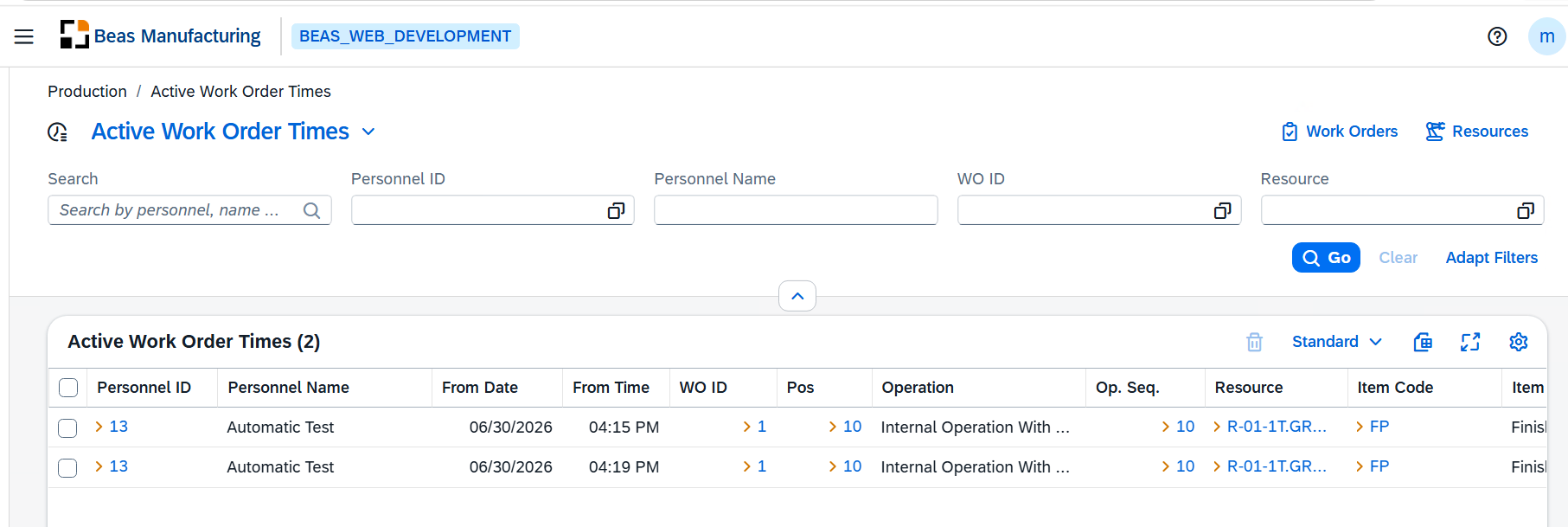
The Active Work Order Times page shows all operators currently clocked in to a work order position — the open time stamps that have not yet been closed by a clock-out. It gives supervisors and production managers a real-time snapshot of who is working on what, on which resource, and since when. The total count of active operators is also shown on the home page dashboard tile.
The home page dashboard shows an Active Operators tile with the count of distinct personnel currently clocked in. Click it to jump straight to this list.
Header
Above the search and filter controls, two buttons give quick access to related master lists:
| Button | Description |
|---|---|
| Work Orders | Opens the Work Orders list, to look up or open any work order without leaving the current search. |
| Resources | Opens the Resources list, to check a resource's status or capacity. |
Type in the search box to search across Personnel ID, Personnel Name and Resource ID at once. Use the individual filter fields for more targeted results.
| Filter | Description |
|---|---|
| Personnel ID | Filter by one or more personnel IDs. Use the lookup to select from the personnel list. |
| Personnel Name | Filter by personnel display name (free text). |
| WO ID | Filter by one or more work order IDs. Use the lookup to select from the work orders list. |
| Resource | Filter by one or more resource IDs. Use the lookup to select from the resources list. |
Press Go to run the search with the current filter values. Press Clear to reset all filters. Press Adapt filters to select any value(s) based on the columns in the list below.
List columns
The grid shows the core fields by default. Use the column settings button to show or hide additional columns.
| Column | Description |
|---|---|
| Icon | A visual icon for the operation type associated with this time stamp. |
| Personnel ID | The personnel ID of the operator who clocked in. |
| Personnel Name | The display name of the operator. |
| From Date | The calendar date when the operator clocked in. |
| From Time | The time of day when the operator clocked in. |
| WO ID | The work order ID. Clicking the link navigates to the parent work order. |
| WO Position | The position line number within the work order. Clicking the link navigates to the position detail page. |
| Operation | The description of the operation being performed. |
| Op Sequence | The internal sequence number of the operation. |
| Resource | The resource (machine or workplace) being used. Clicking the link navigates to the resource detail page. |
| Item Code | The item code of the work order position. |
| Item Name | The item description. |
| Qty Consumption | The quantity recorded as consumed on this time stamp, if any. |
| Unit of Measure | The unit of measure for the consumption quantity. |
Additional columns
Hidden columns are available in the tool bar settings ().
| Column | Description |
|---|---|
| Op Sequence 2 | A second-level sequence number, used when the operation has parallel positions. |
| Operation Text | The operation's activity text, a longer description than the Operation column. |
| Resource Description | The description of the resource, beyond its code. |
| Booking Type | The kind of time being booked (e.g. regular, setup, rework). |
| Closed | Whether the operation this time stamp belongs to has already been closed. |
| Remark | Free text noted on the time stamp. |
| Batch Number | The batch the produced quantity is posted to. |
| Barcode | The operation's barcode, as an alternative to the three operation keys. |
| WO Type | The work order's production type (e.g. Standard, Rework, Repair). |
| Reference | The order that the work order was created from. |
| Customer | The customer code on the work order. |
| Order Date | The date the work order was entered. |
| Delivery Date | The date the finished goods must be delivered to the customer. |
| Time Type | What the booked time counts as. |
| Project | The project code the work order is linked to, for cost tracking. |
| Branch | The business place (branch) the work order belongs to. |
| Takeover | Check mark when this clock-in took over an already-running time stamp from another operator, rather than starting a new one. |
| DIN | The item's DIN designation. |
| Raw Material | The raw material the item is made of. |
| Match Code | A search keyword for the item. |
| Created | Date and time the time stamp was entered. |
| Created By | User who entered the time stamp. |
| Modified | Date and time the time stamp was last changed. |
| Modified By | User who last changed the time stamp. |
| Closed At | Date and time the operation was closed, when Closed is set. |
Removing a time stamp
In some cases a time stamp may need to be removed — for example if an operator forgot to clock out and the entry is now stale.
- Select the row (or rows) you want to remove by clicking the selection check box on the left.
- Click Delete in the toolbar.
- Confirm the deletion in the dialog that appears.
Deleting a time stamp is permanent and cannot be undone. This action requires Full Control permission on the Active Work Order Times resource. Contact your system administrator if the Delete button is not visible.
Navigating to related records
Several columns in the grid are clickable links that take you directly to the related record:
- WO ID → opens the parent work order detail page.
- WO Position → opens the work order position detail page for this line.
- Resource → opens the resource detail page.
The Work Orders and Resources buttons in the header take you to those list views directly, rather than to a single record.
Tips
- Group the list by Personnel or Resource to quickly see all active time stamps per operator or per machine in a collapsed view.
- The home page Active Operators tile refreshes automatically and shows the current count of distinct personnel clocked in. Use it as a quick health check before opening the full list.
This list only shows open (not yet clocked-out) time stamps. To view completed time entries — including clock-out times, durations and costs — use the Production Times page instead.